New publication: "The free-rider detection problem: How groups balance fairness and cooperation"
New comment published in the Proceedings of the National Academy of Sciences.
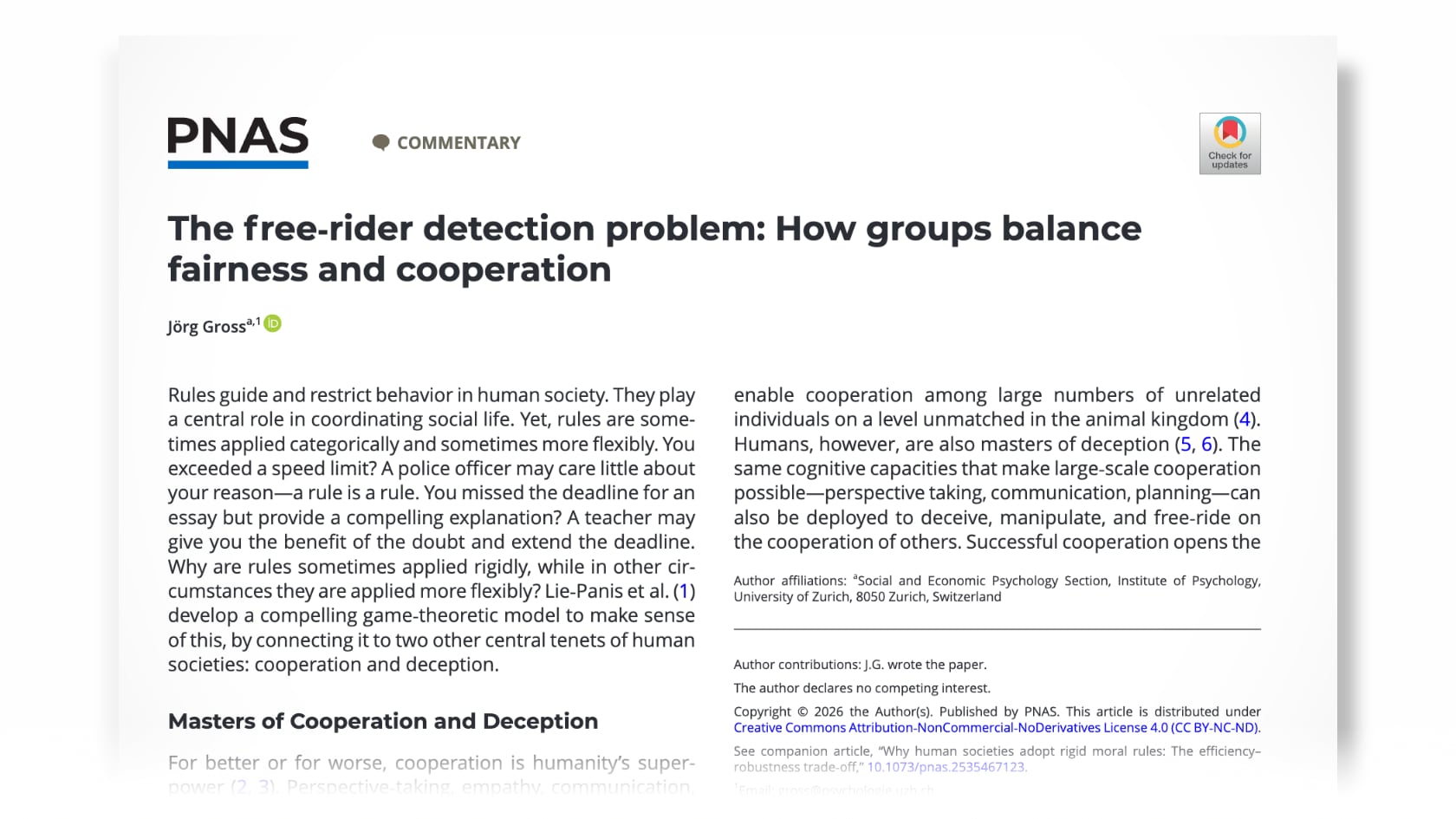
Abstract: Rules guide and restrict behavior in human society. They play a central role in coordinating social life. Yet, rules are sometimes applied categorically and sometimes more flexibly. You exceeded a speed limit? A police officer may care little about your reason—a rule is a rule. You missed the deadline for an essay but provide a compelling explanation? A teacher may give you the benefit of the doubt and extend the deadline. Why are rules sometimes applied rigidly, while in other circumstances they are applied more flexibly? Lie-Panis et al. develop a compelling game-theoretic model to make sense of this, by connecting it to two other central tenets of human societies: cooperation and deception.
Reference: Gross, J. (2026). The free-rider detection problem: How groups balance fairness and cooperation. PNAS, 123 (34), e2622914123.